This research investigates how the shape, size, and surface chemistry of carbon nanomaterials influence their ability to remove contaminants from complex wastewater. By systematically testing nanomaterial variations against pollutants such as microplastics and petroleum derivatives, it aims to establish design rules that enable more effective, real-world water treatment technologies.
This research develops nanobubble-enhanced ultrasound imaging as an accessible alternative to MRI for cancer diagnosis. Tiny gas-filled nanoparticles amplify ultrasound signals and improve image quality, particularly in prostate cancer. The technology could reduce diagnostic delays, lower costs, and provide high-quality medical imaging to more patients worldwide.
This research develops antibacterial nanostructured surfaces inspired by natural materials such as cicada wings. The engineered surfaces physically rupture bacteria using nanoscale needle-like structures, avoiding traditional antibiotics and reducing the likelihood of antibiotic resistance. The technology could improve infection control in medical devices, implants, and hospital environments.
This research develops nanostructured optical devices that dramatically improve camera efficiency by redirecting light rather than discarding unwanted wavelengths. Using nanoscale patterned glass inspired by semiconductor fabrication techniques, the work could produce mobile cameras with significantly better low-light performance, higher image quality, faster imaging, and improved efficiency at ultra-high resolutions.
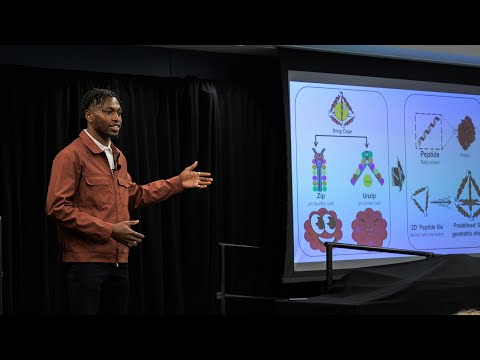
This research develops nanoscale robots made from synthetic DNA capable of navigating and manipulating molecular environments. Using programmable DNA interactions and thermodynamic processes, the work focuses on maze-solving behaviors as a foundation for future applications including allergen removal, nanomaterial assembly, tissue engineering, and programmable molecular systems operating in the physical world.
This research develops photonic integrated circuits that compute using light instead of electrons. By creating integrated all-optical transistors and photonic neural networks, the work advances ultra-fast optical computing systems capable of dramatically outperforming conventional electronic processors in speed, efficiency, and future artificial intelligence applications.
This research develops a quantum transducer, a device that connects quantum computers to fiber optic networks. By converting quantum electrical signals into optical signals at cryogenic temperatures, the technology could enable scalable quantum networking and distributed quantum computing, providing a critical foundation for future large-scale quantum systems and quantum internet infrastructure.
Pagination
- Page 1
- Next page