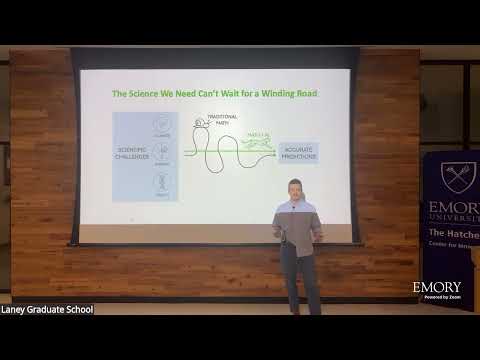
This research uses artificial intelligence to accelerate scientific simulations by learning patterns from traditional mathematical models. Rather than replacing physics, the AI predicts efficient starting points for complex calculations, producing accurate results much faster. The approach could dramatically speed up research in fields such as medicine, engineering, and climate science.
This research develops microscopic copper wire "bridges" that improve heat transfer between computer chips and cooling systems. By reducing chip temperatures by around 3°C, the technology can lower data centre cooling energy by approximately 10%, improving efficiency and supporting more sustainable AI infrastructure.

2026
This research investigates why supersonic aircraft engines fail under turbulent atmospheric conditions. Using high-performance supercomputer simulations, the study models airflow disruptions around supersonic engines to identify early warning signs of instability. The work aims to improve engine reliability and help revive safe, efficient supersonic passenger air travel.

This research addresses the challenge of building stable quantum computers by modelling superconducting qubits. It develops simulation tools to predict behaviour, optimise design, and reduce errors caused by environmental disturbances. By improving qubit reliability, the work supports scalable quantum computing capable of solving complex problems beyond classical computational limits.