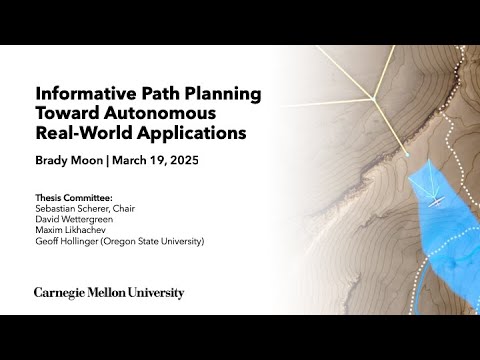
This thesis develops autonomous robotic systems for data gathering in complex real-world environments. It advances three areas: informative path planning, disturbance-aware planning, and predictive world modelling. The research introduces adaptive sampling-based planners for long-horizon information gathering, methods for estimating wind fields and planning safe, energy-aware UAV trajectories, and predictive mapping systems for indoor exploration. It also compares robot exploration strategies with human decision-making and uses those insights to build a reinforcement learning planner that performs at near-human level. Overall, the work shows that integrating long-horizon reasoning, environmental dynamics, and richer belief models can make autonomous robotic information gathering more effective, reliable, and scalable.