This research uses gravitational lensing to investigate dark matter, the invisible substance that makes up roughly 80% of the Universe's matter. By studying distortions in light caused by massive galaxies, it seeks to identify dark matter structures and determine whether dark matter is clumpy, smooth, cold, warm, concentrated, or diffuse.

This research investigates magnetic reconnection, a fundamental plasma process that drives space weather and can disrupt satellites, GPS, and power grids. Using UCLA's Large Plasma Device, the study recreates reconnection events thousands of times in the laboratory to uncover missing physics and improve predictions of solar storms and space-weather hazards.

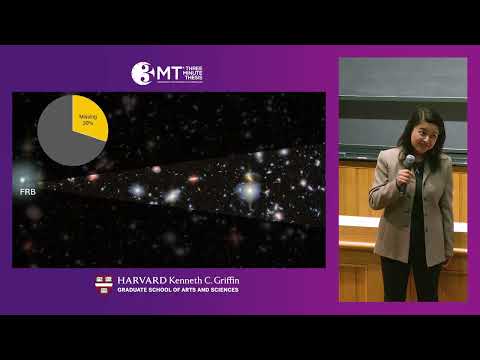
This research investigates the universe’s “missing” ordinary matter using Fast Radio Bursts (FRBs) as cosmic probes. By measuring how FRB signals are delayed while traveling through space, the study reveals that far more matter exists between galaxies than previously estimated, accounting for the long-standing missing baryon problem.

This research investigates gravitational-wave memory, a permanent distortion left in spacetime after black hole mergers. Using computational solutions to Einstein’s equations, the work predicts detectable memory signals for observatories like LIGO, helping probe fundamental spacetime symmetries, gravitational physics, and the connection between classical gravity and quantum theories of the universe.

This research investigates how exoplanets form by analyzing the chemical fingerprints of their host stars. Using stellar abundances and galactic archaeology, the work explores how rocky material shapes planetary systems, whether stars consume planets, and how common Earth-like worlds may be throughout the Milky Way.

This research uses astroseismology — the study of stellar vibrations — to probe the hidden interiors of stars. By analyzing oscillations in red giant stars, the work reveals information about stellar core masses and uncovers evidence of ancient stellar mergers. Listening to stars provides insights impossible to obtain through observation alone.

This research develops advanced telescope technologies for directly imaging exoplanets located near bright stars. Using deformable mirrors and specialized optical screens to suppress starlight, the work aims to capture full-colour images of potentially habitable “Goldilocks” planets, helping scientists study planetary atmospheres, temperatures, and the possibility of extraterrestrial life.

This research investigates extreme binary star systems containing white dwarfs using a multi-wavelength astronomical approach. The study discovered new low-level mass transfer systems, provided evidence for theories of white dwarf magnetism, and identified mysterious radio sources as magnetic binary systems. These findings improve understanding of high-energy astrophysical processes and stellar evolution.

This research identifies potentially habitable rocky exoplanets by measuring their densities, water content, and internal heating through orbital interactions and transit observations. Using these techniques, several promising ocean and volcanic worlds have been identified as targets for the James Webb Space Telescope in the search for extraterrestrial life and habitable environments.

This research investigates the origins of cosmic dust, a critical ingredient for stars, planets, and life. Using infrared observations of massive stellar explosions through the Red Astronomical Transient Survey, the study shows that massive stars produce significant amounts of both silicate and carbon-rich dust, shaping galaxy evolution and early planet formation.