This talk explores how astronomers reconstruct black hole environments using X-ray polarization while reflecting on the fragility of telescopes, scientific archives, and human memory. It connects astrophysical discovery with the preservation of historical records, highlighting the overlooked contributions of women astronomers and the importance of safeguarding scientific heritage.
My thesis describes how laboratory experiments recreate nuclear reactions occurring on accreting neutron stars. By developing a novel particle detection system, I achieved the first simultaneous neutron–proton measurements, enabling more complex studies that illuminate extreme matter, stellar evolution, and the cosmic origins of elements fundamental to life.
2025
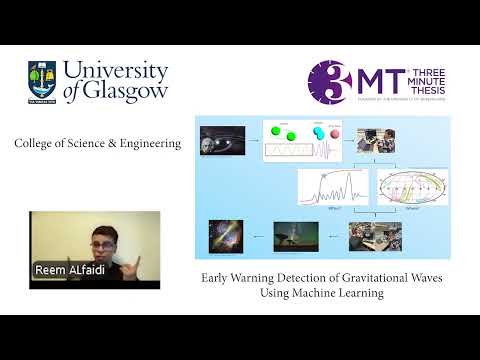
Only five percent of the universe is visible through light, leaving most of it unexplained. Gravitational waves provide a new way to explore this hidden cosmos. By detecting these signals early, researchers can predict cosmic collisions and coordinate telescopes in advance, enabling simultaneous observations that deepen our understanding of the universe.
My talk explains how neutron stars—extremely dense remnants of stellar explosions—contain matter we cannot study on Earth. By analyzing gravitational waves from colliding neutron stars, the speaker models how their deformation (or “squishiness”) reveals their internal composition. This method may uncover entirely new forms of matter and transform fundamental physics.