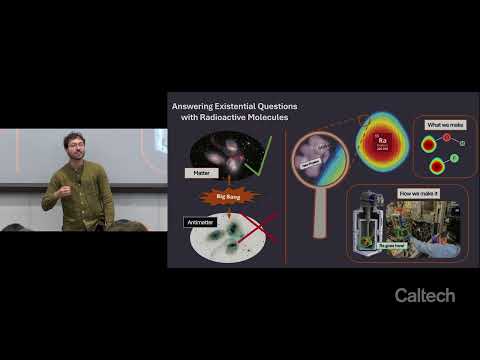
This research develops tabletop methods for studying rare radium-containing molecules to search for broken symmetries between matter and antimatter. Because radium’s asymmetric nuclear structure strongly amplifies subtle physical effects, these molecules provide highly sensitive probes for new physics that could help explain why matter exists in the universe after the Big Bang.
This research investigates the century-old Invar effect in iron–palladium alloys under extreme pressure. Using synchrotron experiments and thermodynamic analysis, the study shows that magnetic entropy and vibrational entropy precisely counterbalance each other, eliminating thermal expansion. The findings reveal strong spin-phonon coupling as a key mechanism underlying pressure-induced Invar behavior.
This research scales neutral-atom quantum computing using optical tweezer arrays containing over 6,100 cesium atoms trapped across 12,000 tweezers. The work demonstrates record coherence times, high-fidelity atom detection, and controllable atom movement, advancing the development of large-scale quantum computers capable of quantum simulation, computation, sensing, and networking.
This research explores quantum radar signal processing, using quantum entanglement to improve detection by better separating signal from noise. It demonstrates that quantum radars are experimentally viable and mathematically comparable to conventional systems, with potential advantages. Applications include low-power, safe technologies such as medical imaging and interference-free sensing.
Inspired by bird flight, this research investigates how wingtip feathers influence aerodynamics. Using bioinspired design, 3D-printed models, and wind tunnel experiments, it isolates the effects of feather separation, bending, and twisting. These insights improve aircraft stability, lift, and maneuverability, offering pathways to safer and more efficient aviation in turbulent environments.
My thesis describes how laboratory experiments recreate nuclear reactions occurring on accreting neutron stars. By developing a novel particle detection system, I achieved the first simultaneous neutron–proton measurements, enabling more complex studies that illuminate extreme matter, stellar evolution, and the cosmic origins of elements fundamental to life.