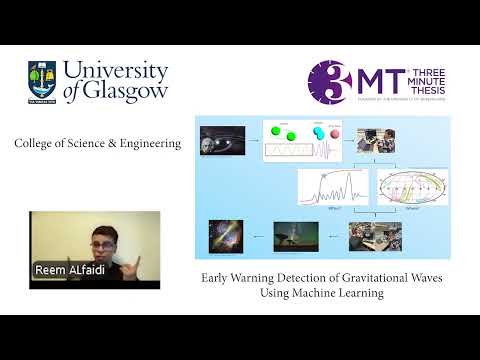
This research investigates gravitational-wave memory, a permanent distortion left in spacetime after black hole mergers. Using computational solutions to Einstein’s equations, the work predicts detectable memory signals for observatories like LIGO, helping probe fundamental spacetime symmetries, gravitational physics, and the connection between classical gravity and quantum theories of the universe.

Only five percent of the universe is visible through light, leaving most of it unexplained. Gravitational waves provide a new way to explore this hidden cosmos. By detecting these signals early, researchers can predict cosmic collisions and coordinate telescopes in advance, enabling simultaneous observations that deepen our understanding of the universe.
My talk explains how neutron stars—extremely dense remnants of stellar explosions—contain matter we cannot study on Earth. By analyzing gravitational waves from colliding neutron stars, the speaker models how their deformation (or “squishiness”) reveals their internal composition. This method may uncover entirely new forms of matter and transform fundamental physics.