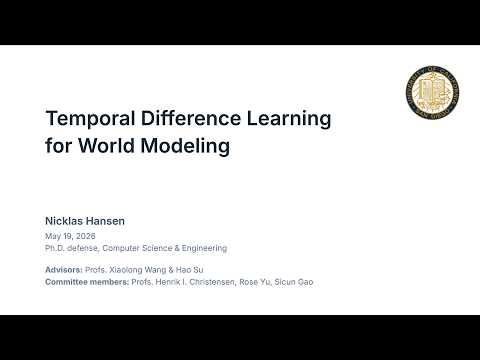
This dissertation presents temporal-difference learning methods for building world models that enable intelligent agents and robots to predict, plan and act. It introduces TD-MPC, which learns compact latent dynamics, rewards and value estimates for model-predictive control, and TD-MPC2, a more robust successor requiring little task-specific tuning. Experiments demonstrate faster real-world robot learning, scalable multitask performance and a unified model spanning 200 tasks across ten domains. The research also examines interactive generative world models and their tendency to hallucinate physically implausible futures. Targeted data collection in uncertain regions substantially reduces these errors, suggesting routes toward safer, uncertainty-aware autonomous systems and robotics.
This research combines galaxy simulations with machine learning to study the invisible gas surrounding galaxies. By training a neural network to interpret astronomical observations, the project creates a public tool—the Circumgalactic Dictionary—that enables previously impossible measurements, advancing our understanding of galaxy evolution and the origins of stars, planets, and life.
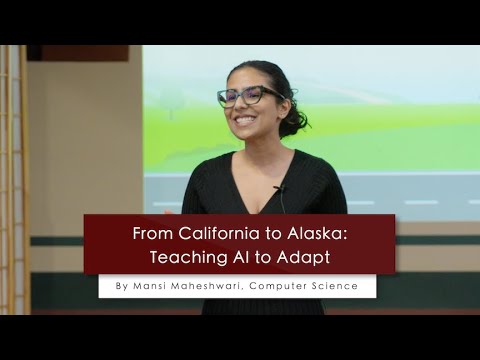
This research explores how artificial intelligence systems can continue learning without forgetting previously acquired knowledge. Instead of erasing old information, the proposed method compresses knowledge into more efficient representations, allowing AI systems such as self-driving cars to adapt safely to new environments while avoiding dangerous performance failures during learning.
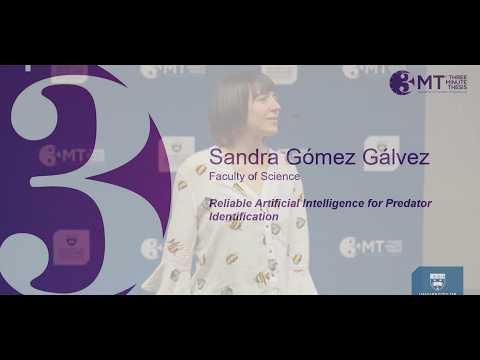
This research develops reliable AI-powered drone systems to support New Zealand’s Predator Free 2050 initiative. By improving neural network calibration, uncertainty estimation, and robustness in challenging real-world conditions, the project aims to accurately detect invasive predators and better protect endangered native bird species.
This thesis introduces Armando, a low-cost soft robotic gripper with proprioceptive sensing using a single flexible capacitive sensor and neural-network decoding. Achieving 99% accuracy, Armando enables precise finger-position estimation for applications in prosthetics, assistive care, and disaster response, advancing accessible tactile robotics inspired by human touch.