This research studies neutrinos—elusive particles that rarely interact with matter—and their ability to change type, known as neutrino oscillation. Using detectors in Japan, the experiment compares neutrinos before and after travel. Improved near-detector accuracy enables precise measurements, helping explain fundamental questions about matter, antimatter, and the structure of the universe.
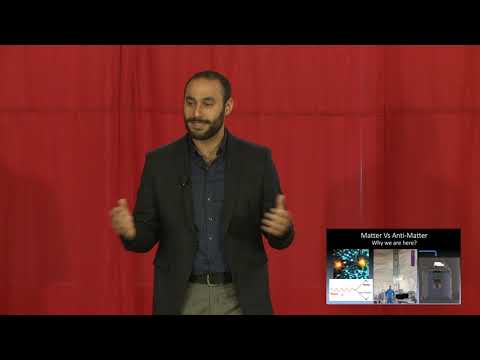
This research investigates why matter dominates over antimatter in the universe. By isolating xenon isotopes deep underground, scientists aim to detect rare nuclear reactions that could explain this imbalance. The work involves large-scale gas processing and long-term observation, potentially revealing fundamental insights into the origin of matter and existence.

2026
This research searches for dark matter, which makes up most of the universe’s mass, by detecting ultralight particles using sensitive quantum sensors. By scanning frequencies like a radio and minimizing noise at cryogenic temperatures, the experiment aims to identify faint signals, bringing scientists closer to understanding the fundamental composition of the universe.
This research investigates the tilt of exoplanets to understand their formation and evolution. By developing a new measurement method, it identifies a Uranus-like tilted planet and enables broader study of planetary systems. These insights help reveal climates, histories, and potential habitability of distant worlds beyond our solar system.
2026
This research investigates whether dark energy, responsible for the universe’s accelerating expansion, evolves over time rather than remaining constant. Using galaxy distributions, supernovae, and cosmic microwave data, new statistical methods suggest evolving models may better fit observations, potentially reshaping our understanding of cosmology and the universe’s long-term fate.

This research demonstrates that turbulence in galaxy clusters generates radio halos through synchrotron radiation from cosmic ray electrons. By linking large-scale astrophysical processes to familiar physical principles, it explains the origin of cluster emissions and advances understanding of how galaxy clusters form, merge, and evolve.
Dark matter makes up most of the universe but cannot be directly observed. This research studies how dark matter halos evolve using cosmological simulations and the principle of maximum entropy. Results show halo entropy increases over time, indicating their evolution toward equilibrium follows fundamental thermodynamic principles.
2025
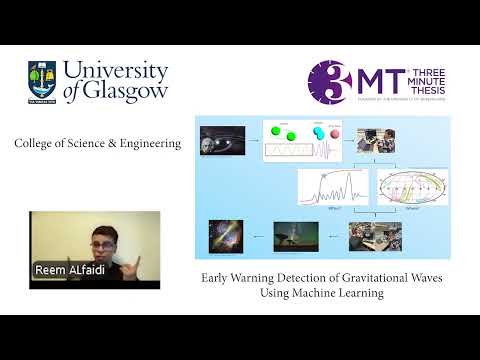
Only five percent of the universe is visible through light, leaving most of it unexplained. Gravitational waves provide a new way to explore this hidden cosmos. By detecting these signals early, researchers can predict cosmic collisions and coordinate telescopes in advance, enabling simultaneous observations that deepen our understanding of the universe.
My talk explains how neutron stars—extremely dense remnants of stellar explosions—contain matter we cannot study on Earth. By analyzing gravitational waves from colliding neutron stars, the speaker models how their deformation (or “squishiness”) reveals their internal composition. This method may uncover entirely new forms of matter and transform fundamental physics.

The researcher studies how clouds on distant exoplanets affect their climates and potential for life. Working with NASA, they model how exotic materials—like iron or sapphire clouds—absorb and reflect light. They found particle shape greatly influences temperature and habitability, helping determine whether alien worlds could support liquid water and life.