
This research investigates how the structure of comb polymers influences their ability to stabilize materials in applications ranging from fragrances and food products to wastewater treatment and drug delivery. By systematically modifying polymer architecture, the study identifies design rules that enable more effective, affordable, and targeted performance across diverse industrial and medical uses.

This research develops antibacterial nanostructured surfaces inspired by natural materials such as cicada wings. The engineered surfaces physically rupture bacteria using nanoscale needle-like structures, avoiding traditional antibiotics and reducing the likelihood of antibiotic resistance. The technology could improve infection control in medical devices, implants, and hospital environments.

2025
This research develops a new chemical process for modifying cellulose while keeping it in water, overcoming longstanding compatibility problems between cellulose and oil-soluble molecules. The method enables cellulose to incorporate electronic and pharmaceutical components, opening pathways toward sustainable electronics, advanced materials, targeted medicines, and greener technologies based on renewable natural resources.

2026
This research improves iron oxide nanoparticles for pollutant removal by addressing aggregation issues. Using pectin surface modification, particularly low methoxyl pectin via functionalization, enhances stability and adsorption efficiency. The modified nanoparticles achieve up to 95% methylene blue removal, demonstrating a significant improvement for environmental remediation applications.
2026
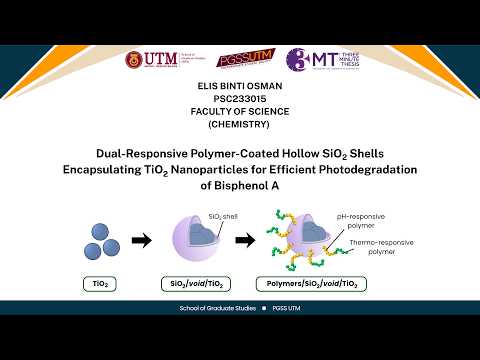
This research tackles removal of Bisphenol A from water using light-activated materials. By combining titania with a silica shell and a responsive polymer “gate,” the system adapts to changing conditions like pH and temperature, improving pollutant breakdown under visible light and enabling smarter, more efficient water purification.

2026
This research investigates zinc batteries as a safer, cheaper alternative to lithium batteries. By studying the microscopic passive layer formed between zinc and electrolyte, it identifies mechanisms that improve performance and prevent failure. The work aims to enable more reliable, ethical, and fire-safe energy storage technologies through detailed materials analysis.
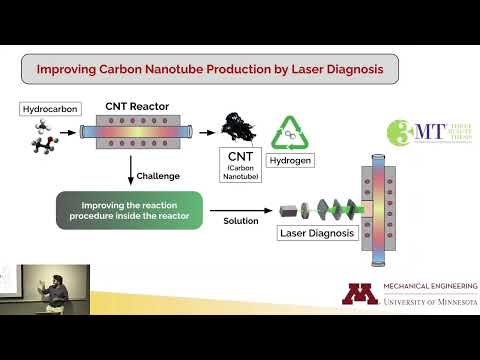
Hydrocarbons drive modern society but fuel climate change when burned. This research converts hydrocarbons into carbon nanotubes and clean hydrogen instead. Using laser diagnostics to probe reactors, it reveals how nanotubes form, enabling higher production rates, industrial decarbonization, and advanced materials for a sustainable, low-carbon energy future.

This research explores human motion as a renewable energy source using nanogenerators made from nanomaterials. By converting everyday body movement into electricity, the work demonstrates a novel, sustainable approach to reducing reliance on fossil fuels and supporting a cleaner energy future.

This research develops a theoretical framework for understanding electron–hole interactions in quantum dots, focusing on positive and negative trions. By analytically modeling their behavior under electric and magnetic fields, it bridges gaps between theory and experiment, supporting advances in quantum electronics, energy technologies, and targeted medical applications.