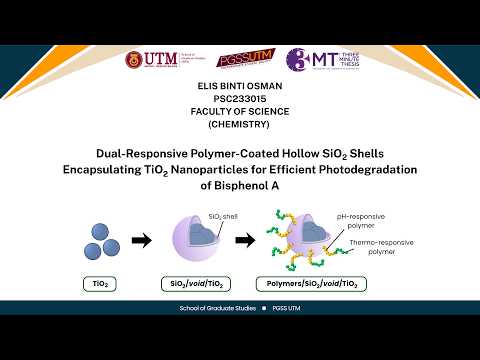
This research tackles removal of Bisphenol A from water using light-activated materials. By combining titania with a silica shell and a responsive polymer “gate,” the system adapts to changing conditions like pH and temperature, improving pollutant breakdown under visible light and enabling smarter, more efficient water purification.

2026
2025
This research advances artificial photosynthesis by developing a dual-function “two-way” material that combines electrical conductivity and CO₂ adsorption. By pairing this material with simple powder-based fabrication, the study achieves dramatically improved reaction speed and efficiency, enabling scalable, sustainable carbon-neutral energy systems.
PFAS “forever chemicals” contaminate water, food, and air and accumulate in the body, causing serious health risks. This research develops a light-activated porous material that traps and breaks down PFAS molecules. Tested in real-world water and now being scaled up, the method aims to provide a practical, permanent solution for removing PFAS and protecting safe drinking water.