This research investigates mating behavior in Siamese fighting fish and reveals that visual interaction dramatically increases reproductive success. By studying 203 breeding pairs, the project demonstrates the importance of sight in social and mating behavior, suggesting that betta fish possess more sophisticated visual and individual recognition abilities than previously understood.
This research investigates how the olfactory system of the Spanish ribbed newt adapts between aquatic and terrestrial environments. By analyzing cellular and genetic changes in the nose, the study reveals remarkable sensory plasticity, offering broader insights into nervous system flexibility and potential implications for understanding neurodegenerative diseases such as dementia.
This research investigates how differences in butterfly behavior relate to brain evolution and memory. Heliconius butterflies showed superior long-term memory and enlarged mushroom body brain regions compared with related species. The work explores how neurogenesis shapes cognition and may ultimately contribute to understanding memory, brain development, and neurological disorders.
This research uses the Manhattan maze to study rapid learning and memory in mice. The study demonstrates that mice can acquire complex navigation sequences after only a few rewards, retain memories overnight, and generalize learned strategies to new mazes. The findings provide insights into few-shot learning, memory formation, and adaptive intelligence.
This research investigates ground locomotion in bats, focusing on the endangered Eastern small-footed bat. Using treadmill experiments in the field, it reveals that bats can move effectively on the ground. Findings suggest ground behavior may be underestimated, with important implications for habitat use, risk exposure, and conservation strategies.
This research shows that damselfly species lose color variation when living together, adopting distinct colors to avoid misidentification and conflict. Experiments reveal they cannot distinguish species when polymorphic, leading evolution to favor visual divergence. The findings illustrate how natural selection can reduce aggression and promote coexistence between closely related species.
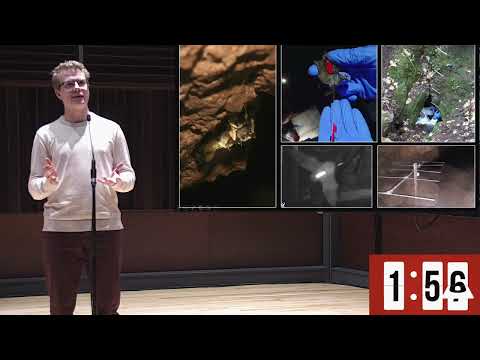
In the cool depths of a limestone cave, temperature, humidity, and darkness are constant — ideal conditions for hibernators to save energy over winter. Endangered little brown bats (Myotis lucifugus) may hibernate for up to eight months, emerging in spring with minimal stored fat. Exiting the cave on warm, calm days with higher insect activity could provide an opportunity to forage and recover from hibernation. But without weather cues from the outside world, how might hibernating bats anticipate good conditions for emergence? Atmospheric pressure changes, which precede warm and cold fronts, are sensed by many animals, and little brown bats appear to synchronize activity during hibernation with pressure patterns as spring approaches. Using infrared cameras and radio telemetry, my research monitors the activity of bats throughout their hibernation at a Manitoba cave to reveal how air pressure and weather influence their emergence timing and behaviour.

Bumblebees navigate complex environments by using optic flow—the motion of images across their eyes—to estimate speed and detect obstacles. Unlike other insects that rely on lateral optic flow, bumblebees monitor the frontal-lateral field to see hazards earlier. This research reveals how bees avoid collisions and informs bio-inspired flight control.