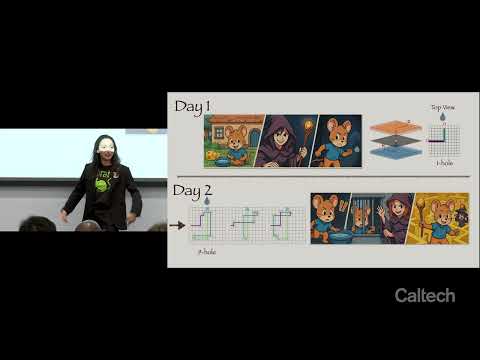
This research uses the Manhattan maze to study rapid learning and memory in mice. The study demonstrates that mice can acquire complex navigation sequences after only a few rewards, retain memories overnight, and generalize learned strategies to new mazes. The findings provide insights into few-shot learning, memory formation, and adaptive intelligence.
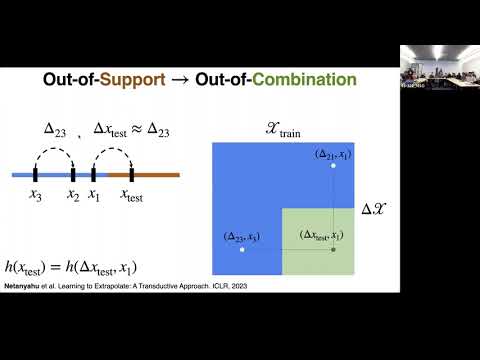
This defense addresses generalization under distribution shift with limited data. It introduces (1) diffusion-based inverse task inference that recovers a task embedding from a few demonstrations, enabling compositional generation without fine-tuning; and (2) bilinear transduction that converts out-of-support inputs into out-of-combination problems, yielding zero-shot extrapolation in robotics and property prediction.