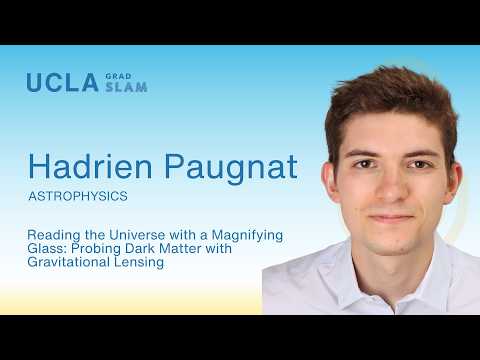
This research uses gravitational lensing to investigate dark matter, the invisible substance that makes up roughly 80% of the Universe's matter. By studying distortions in light caused by massive galaxies, it seeks to identify dark matter structures and determine whether dark matter is clumpy, smooth, cold, warm, concentrated, or diffuse.

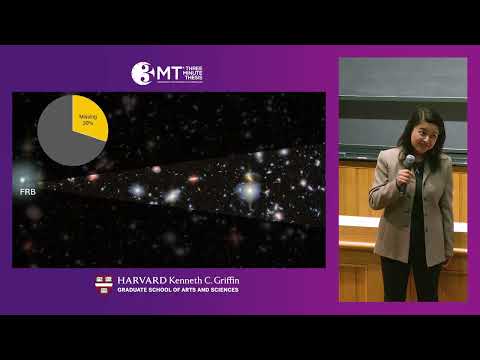
This research investigates the universe’s “missing” ordinary matter using Fast Radio Bursts (FRBs) as cosmic probes. By measuring how FRB signals are delayed while traveling through space, the study reveals that far more matter exists between galaxies than previously estimated, accounting for the long-standing missing baryon problem.

This research explores the philosophical foundations of particle physics and the Standard Model. Focusing on neutrinos, it argues that these particles may be better understood as different states of a single entity rather than separate objects. The project aims to develop a deeper ontology describing the fundamental structure of physical reality.

This research investigates gravitational-wave memory, a permanent distortion left in spacetime after black hole mergers. Using computational solutions to Einstein’s equations, the work predicts detectable memory signals for observatories like LIGO, helping probe fundamental spacetime symmetries, gravitational physics, and the connection between classical gravity and quantum theories of the universe.

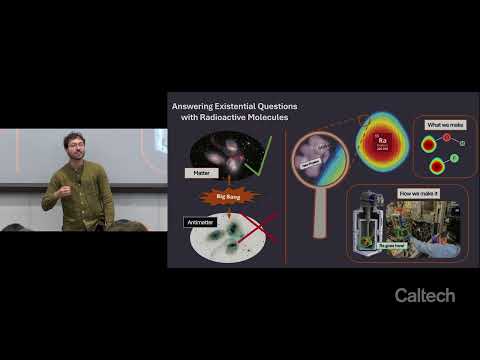
This research develops tabletop methods for studying rare radium-containing molecules to search for broken symmetries between matter and antimatter. Because radium’s asymmetric nuclear structure strongly amplifies subtle physical effects, these molecules provide highly sensitive probes for new physics that could help explain why matter exists in the universe after the Big Bang.

This research investigates the origins of cosmic dust, a critical ingredient for stars, planets, and life. Using infrared observations of massive stellar explosions through the Red Astronomical Transient Survey, the study shows that massive stars produce significant amounts of both silicate and carbon-rich dust, shaping galaxy evolution and early planet formation.

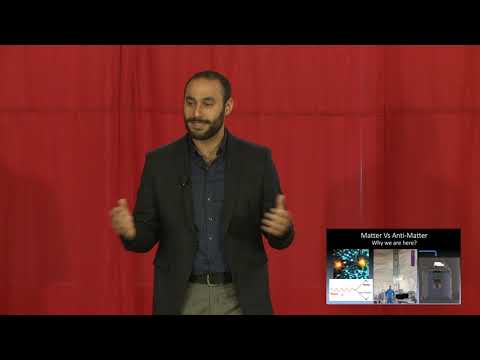
This research investigates why matter dominates over antimatter in the universe. By isolating xenon isotopes deep underground, scientists aim to detect rare nuclear reactions that could explain this imbalance. The work involves large-scale gas processing and long-term observation, potentially revealing fundamental insights into the origin of matter and existence.

This research investigates whether dark energy, responsible for the universe’s accelerating expansion, evolves over time rather than remaining constant. Using galaxy distributions, supernovae, and cosmic microwave data, new statistical methods suggest evolving models may better fit observations, potentially reshaping our understanding of cosmology and the universe’s long-term fate.