This talk explains research that teaches legged robots how to walk reliably using machine learning, computer vision, advanced control theory, and Lyapunov-based safety guarantees. By improving robot stability on complex terrain, the work moves us closer to versatile, household multi-purpose robots capable of performing everyday chores safely and independently.

This talk reframes the myth of Icarus to explain modern challenges in spacecraft design. Flexible solar panels deform in sunlight, limiting performance. The researcher builds and models new thermally stable “spacecraft wings” that resist bending and overheating, enabling larger, lighter, more reliable structures for future deep-space exploration.

This research introduces a computational method that detects up to one trillion RNA viruses hidden in standard RNA-sequencing data. By targeting protein signatures shared across all RNA viruses, the approach reveals viral RNA that previously went unnoticed. This enables large-scale viral discovery, tracking, and potential breakthroughs in understanding disease mechanisms.

This research develops stable-isotope tools to measure how microbes—the Earth’s “lungs”—breathe CO₂ in and out. Microbes are massively abundant and shape global climate. Findings show deep subsurface environments slowly emit CO₂, a process that may influence future climate dynamics as human-driven environmental changes accelerate.

This talk explains magnetic refrigeration, a sustainable cooling technology that uses magnetocaloric materials to generate heating and cooling through controlled changes in magnetic and lattice entropy. The research focuses on tuning Curie temperatures—especially via cobalt substitution—and understanding first- vs second-order transitions to design efficient, environmentally friendly refrigeration materials.

This talk explains the challenge of detecting Earth-like exoplanets, the noise caused by stellar activity, and how a solar calibration instrument helps disentangle star signals from planetary ones. The speaker also studies extreme exoplanet systems, revealing surprising orbital alignments that challenge theories of giant-planet migration and highlight how much we still don’t understand.


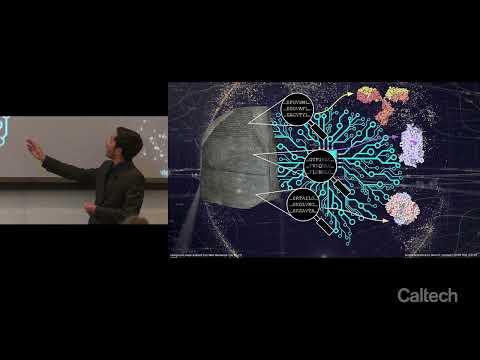
The talk describes using AI language models to decipher the hidden “languages” within millions of natural protein sequences. By learning protein vocabulary, syntax, and grammar, researchers can design new molecules that fight cancer, degrade plastics, capture carbon, and expand biology beyond nature’s rules—advancing medicine, sustainability, and molecular engineering.

This project develops a 200-metre space reflector antenna using a modular “LEGO-like” assembly system. Designed for compact launch and robotic construction, it enables stronger, higher-quality interstellar communication. The work also models structural behaviour during assembly and could support building other large space structures, advancing deep-space exploration.

This research uncovers a newly identified neural cluster that controls how much sodium animals want based on internal bodily state. By activating or inhibiting these neurons, salt perception can be shifted without changing food content. Their accessibility and immune-linked receptors offer promising targets for treating sodium overconsumption and related health disorders.

This research uncovers 400 “zombie stars”—dead white dwarfs revived through collisions with companion stars. Their dramatic brightness changes allow astronomers to detect them and use them as probes into the galaxy’s ancient history and future evolution. These rare reanimated stars offer a powerful new tool for understanding the Milky Way.