This research introduces the first simple mathematical model capable of capturing the cooperative folding of alpha helices, a fundamental protein structure. By revealing how these proteins fold, stabilize, and misfold, the model offers new insights into diseases such as Alzheimer's and Parkinson's while providing a fast, flexible platform for protein research.

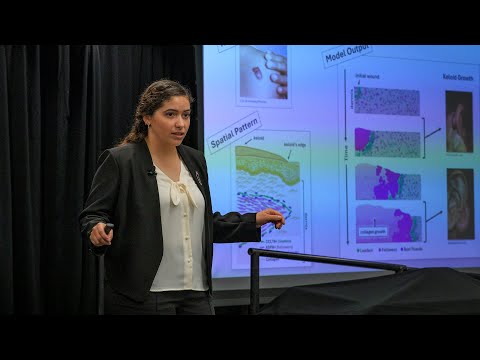
This research uses agent-based mathematical modelling to study keloid scar growth. By simulating interactions among collagen, immune cells, and key scar-associated cell types, the model predicts how keloids expand without requiring harmful patient experiments. The approach may guide future treatments for keloids and broader skin-healing conditions.

This thesis examines cytokine release storm, where the immune system becomes dangerously overactive. Using rat models, mathematical modelling, science and coding, she maps how corticosteroids move through organs and control inflammation. The goal is to optimise treatment for CRS during cancer therapy, COVID or future pandemics.

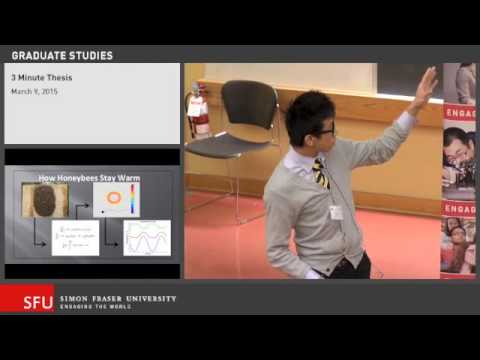
This research develops mathematical models to understand how honeybee clusters survive extreme cold without their hive. Using temperature and density equations, the model predicts how bees move, generate heat, and form insulating layers. Accurate simulations could reduce harmful field experiments and provide biologists with a powerful tool for studying bee behaviour.

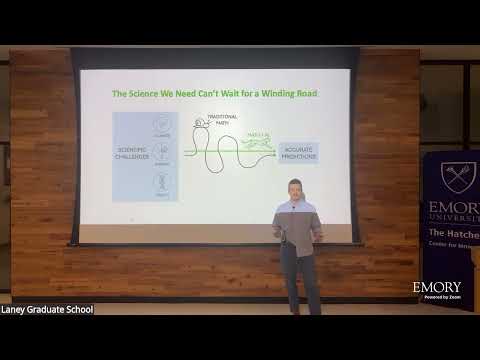
This research quantifies the uncertainty in chaotic systems, showing why long-term predictions — from planetary motion to weather patterns — become unreliable. By developing mathematical models that capture chaotic behaviour, the work supports applications in traffic flow, wireless communication, climate forecasting, and disease spread, revealing why some systems are inherently more predictable than others.

This research explores how to secure low-power Internet of Things devices using physical-layer security. Instead of relying on computational cryptography, it harnesses randomness in wireless communication channels to achieve strong or even perfect security. As 5G expands device numbers, understanding these mathematical limits is essential for protecting future networks.