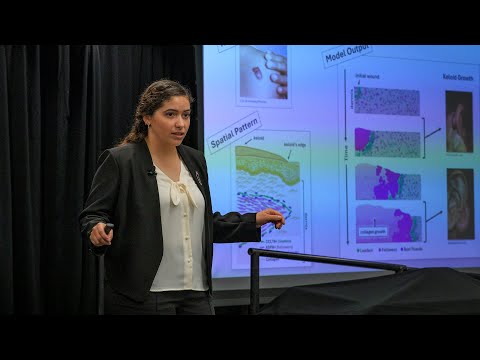
This research uses agent-based mathematical modelling to study keloid scar growth. By simulating interactions among collagen, immune cells, and key scar-associated cell types, the model predicts how keloids expand without requiring harmful patient experiments. The approach may guide future treatments for keloids and broader skin-healing conditions.
2025
2025
Healing depends on a balance between extracellular matrix stiffness and cellular recycling through autophagy. This research shows that disrupted balance leads to chronic wounds or fibrotic scarring. By engineering materials with tunable stiffness, the work reveals how cells “sense” their environment, opening new paths to guide healthier wound healing.
Corneal scarring causes widespread vision loss and is poorly treated by transplantation alone. This research develops a bioengineered corneal glue that both seals and heals wounds by promoting cell infiltration and reducing fibrosis. The approach enables scar-free healing, lowers transplant rejection risk, and offers a regenerative alternative to sutures and conventional sealants.