Employers have long said that communication matters. New evidence suggests something slightly more important: they increasingly want graduates to prove that they can communicate, rather than simply claim that they can.
The National Association of Colleges and Employers (NACE) Job Outlook 2026 Spring Update reports that, when recruiting graduates for entry-level positions, employers are particularly looking for evidence of three core capabilities: teamwork, problem-solving and communication. More than half of the employers surveyed identified ten or more different skills they wanted to see in candidates.
This reflects a broader change in graduate recruitment. According to NACE, 70% of employers now report using skills-based hiring, up from 65% the previous year, and 71% of those employers use it at least half of the time.
The degree still matters. But increasingly, employers want to know what a graduate can actually do.
The important word is “evidence”
This creates an interesting problem for universities and students.
A CV can say:
Excellent communication skills.
But what does that actually demonstrate?
Almost every graduate can make the same claim. Employers therefore increasingly look for examples: situations in which candidates have communicated complex ideas, worked with others, solved problems or explained something clearly to a particular audience.
NACE's advice is essentially show, don't just tell. Students need to identify experiences in which they have developed these skills and be able to articulate them during applications and interviews.
Communication is particularly interesting because, unlike many graduate attributes, it can actually be demonstrated.
A student does not have to tell an employer that they are a good communicator.
They can show them.
A short research talk is evidence
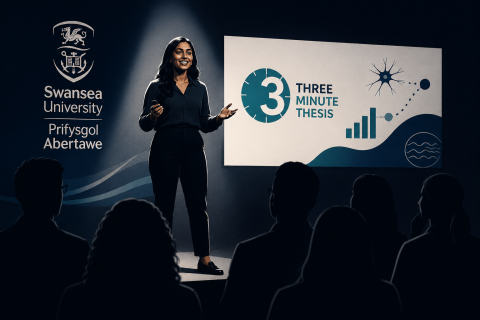
This is one reason initiatives such as the Three Minute Thesis (3MT) are potentially much more significant than simply being academic competitions.
A researcher taking part in a 3MT has to explain a complex piece of research to a non-specialist audience in just three minutes.
Doing that successfully requires several transferable skills simultaneously.
The speaker has to identify what is important, discard unnecessary technical detail, structure an argument, communicate clearly, engage an audience and work within a strict constraint.
Those are not abstract claims about employability. They are observable behaviours.
And they are remarkably close to the capabilities employers say they want.
The distinction matters because employers themselves see room for improvement. NACE's 2026 research found that employers rank communication among the most important career-readiness skills for new graduates, but are less impressed with graduates' communication abilities than with their teamwork skills.
For postgraduate researchers, the issue may be particularly acute. A PhD provides compelling evidence of technical expertise, persistence and intellectual ability, but those qualities may not be immediately apparent to someone recruiting outside the candidate's specialist discipline.
Being able to explain that research clearly changes the equation.
From CV to evidence portfolio
Graduate recruitment may therefore be moving towards something closer to a portfolio model of employability.
Instead of merely listing attributes—
- Communication
- Critical thinking
- Leadership
- Problem-solving
—graduates will increasingly benefit from being able to attach evidence to them.
For software developers, that might be a GitHub repository.
For designers, it is already standard practice to provide a portfolio.
For researchers, one of the simplest forms of evidence could be a short video demonstrating their ability to communicate their work.
This is where platforms such as my-thesis.org can potentially play a useful role.
my-thesis indexes short research presentations and connects them to searchable researcher profiles. Rather than allowing a three-minute presentation to disappear after a university competition or graduation ceremony, it can become part of a researcher's persistent professional identity.
A graduate applying for a role can therefore point to something concrete:
Here is my research. Here is how I explain it. Here is evidence that I can communicate complex ideas clearly.
That is considerably more informative than writing excellent verbal communication skills on a CV.
Communication matters beyond academia
The relevance also extends well beyond students intending to remain in universities.
NACE's findings concern entry-level employment generally, and the continued growth of skills-based recruitment means that employers are deliberately looking beyond degree subject and academic performance when assessing candidates.
This is potentially good news for postgraduate researchers.
A doctoral student investigating gravitational waves, cancer biology, medieval history or machine learning may apply for a career in which the precise subject of their thesis is not directly relevant.
What remains highly transferable is their ability to understand difficult material, identify the important information and explain it to somebody who is not an expert.
A short research presentation makes that ability visible.
Universities can help students create the evidence
There is an implication here for graduate schools and careers services as well.
If employers are moving towards evidence-based assessment of skills, universities should not only teach those skills. They should help students produce portable evidence that they possess them.
A presentation should therefore not necessarily be regarded as a transient classroom exercise or a competition entry that disappears once it has been assessed.
It can be a professional asset.
Universities already encourage students to build CVs, LinkedIn profiles and records of extracurricular activities. Short research communication should increasingly be considered part of that same employability infrastructure.
The question for graduates may soon be changing from:
“Do you have good communication skills?”
to:
“Can you show me?”
For thousands of postgraduate researchers who have already stood up and explained years of work in three minutes, the answer could be sitting in a video that already exists.
The challenge is making sure employers can find it.