Image
THE

Artificial intelligence is changing higher education at a remarkable pace.

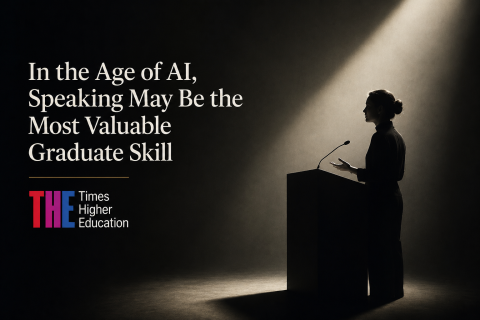
In a recent opinion piece for Times Higher Education, Bruce Hood argued that as AI becomes increasingly capable of producing polished written work, universities must rethink how they develop and assess one of the most important graduate attributes: the ability to communicate knowledge effectively to other human beings.

For decades, universities have focused primarily on written communication. Essays, reports, dissertations and examinations have been the traditional ways students demonstrate understanding. But the emergence of generative AI raises an uncomfortable question: if a machine can help produce convincing written work, how can employers, educators and society distinguish between possessing knowledge and simply presenting it?

The answer may lie in a skill that has often been overlooked within higher education: spoken communication.

Communication Beyond Writing

The ability to explain complex ideas clearly has always mattered. Whether presenting research, pitching a business proposal, explaining technical concepts to clients, or leading a team, professional success often depends on communicating knowledge effectively.

Employers recognise this. Across multiple surveys, verbal communication consistently ranks among the most sought-after graduate attributes. Yet many students complete their degrees having received relatively little formal training in public speaking, audience engagement or persuasive communication.

This is particularly surprising given that communication is not simply the transmission of information. Effective speakers must think on their feet, respond to questions, establish credibility, build trust and adapt to their audience in real time. These are deeply human skills that AI cannot easily replicate.

Knowledge Is Not Enough

Good communication begins with understanding.

One concern is that AI may allow students to engage less deeply with the material they are studying. If students rely on AI to generate essays and reports, they may miss the intellectual struggle that often produces genuine comprehension.

But even deep knowledge is not sufficient on its own.

Many graduates possess considerable expertise but struggle to explain it to non-specialists. Anyone who has attended an academic conference knows that expertise and communication ability do not always go hand in hand.

Communication is a skill that requires practice, feedback and repetition. Like any complex ability, it improves through deliberate effort.

Why Three Minute Thesis Matters

This is one reason the Three Minute Thesis (3MT®) competition has become such a global success.

Developed by the University of Queensland and now adopted by more than a thousand institutions worldwide, 3MT challenges doctoral researchers to explain years of work in just three minutes using language that a general audience can understand.

The challenge is deceptively difficult.

Researchers must identify the core message of their work, strip away unnecessary jargon, construct a compelling narrative and connect with an audience that may know nothing about their field.

In doing so, they develop precisely the communication skills that employers, policymakers, journalists and the public increasingly value.

The Problem of Visibility

Yet there is another challenge.

Every year, thousands of students participate in competitions, public engagement events, conference presentations and research showcases. These experiences develop valuable communication skills, but the evidence often disappears once the event concludes.

A presentation may be uploaded to YouTube, buried within a university playlist, and never seen again.

The achievement itself becomes difficult to discover, verify or showcase.

Why My-Thesis?

My-Thesis was created to address this problem.

The platform provides a searchable index of research presentations, enabling graduate researchers to make their talks more discoverable and giving audiences a way to find research by topic, institution, researcher or keyword.

But the platform is about more than research visibility.

At its core, My-Thesis recognises communication as an academic achievement in its own right.

A successful presentation demonstrates not only what a researcher knows but also their ability to explain, persuade and engage. These are increasingly important skills in a world where information is abundant but understanding remains scarce.

Looking Forward

Artificial intelligence is undoubtedly transforming education. Universities will continue to debate how best to assess knowledge and maintain academic integrity in an age of AI-assisted learning.

However, one consequence seems increasingly clear.

The graduates who thrive will not simply be those who possess knowledge. They will be those who can communicate it effectively, authentically and persuasively.

The ability to stand in front of an audience and explain an idea clearly may become one of the most valuable skills a graduate can possess.

And that is precisely why platforms such as My-Thesis matter more than ever.
Image
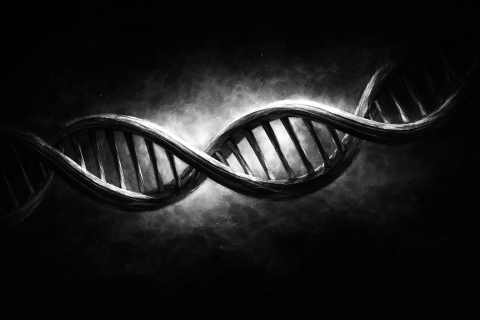
Representation of DNA

For centuries, Leonardo da Vinci has stood as the archetype of the Renaissance mind: a polymath whose mastery spanned painting, anatomy, engineering, and natural philosophy. Today, a new frontier of inquiry is emerging at the intersection of art history and molecular biology—a frontier that illustrates how modern research tools can illuminate centuries-old mysteries in unexpected ways.

In early January 2026, scientists reported finding male human DNA on a fragile red chalk drawing known as Holy Child, a work associated by some experts with da Vinci’s hand. Check out our my-thesis speakers from North Carolina and Dalhousie  to hear a bit more about DNA.

This result comes from the ongoing Leonardo da Vinci DNA Project (LDVP), an ambitious, decade-long international effort to locate biological material that could be linked to the Renaissance master.

The project’s goals reach beyond a simple curiosity about genetic material; they speak directly to questions of authorship, historical verification, and the nature of evidence in disciplines that rarely meet.

Why DNA on a Drawing Matters to Researchers

On its face, swabbing DNA from a chalk drawing may seem like the sort of novelty that makes headlines but contributes little to scholarship. In reality, this work embodies several key research principles that are deeply relevant for doctoral scientists and interdisciplinary problem-solvers.

  1. Methodological Innovation:
    Applying genetic sequencing to ancient artifacts without damaging them required novel sampling methods. Artworks on paper are porous and fragile; scientists developed gentle swabbing techniques to lift trace biological material — including skin cells and microbes — while preserving the integrity of the piece.
  2. Interdisciplinary Collaboration:
    The LDVP integrates expertise from genetics, archaeology, art history, and conservation science. This alignment of domains illustrates a broader trend in research where complex questions demand collaborative solutions that transcend traditional disciplinary boundaries.
  3. Evidence and Uncertainty:
    At present, researchers cannot conclusively prove that the DNA fragments belong to da Vinci himself. The historical record lacks verified genetic material from the artist because his burial site in Amboise, France, was disturbed in the early 19th century, and no confirmed direct descendants exist. 
    This uncertainty does not diminish the research; instead, it underscores a core research reality: strong inquiry often progresses through incremental evidence, even when definitive answers remain out of reach.

Beyond Nostalgia: The Real Scientific Promise

The implications of this work extend beyond confirming da Vinci’s genetic identity. If researchers can reliably capture authentic biological material from art objects, several practical research applications emerge:

  • Art authentication: Genetic signatures could provide an additional layer of evidence when determining whether disputed works were created by a specific artist or workshop.
  • Cultural heritage science: Understanding the bio-archives embedded in historical objects offers insights into how artifacts were handled, stored, and conserved over time.
  • Advanced provenance research: Combining genetic clues with traditional art historical methods could help clarify long-standing attribution debates.

In this sense, the project isn’t just about who made a piece — it represents a methodological shift in how researchers think about evidence in human history. It shows that biology and the humanities can intersect productively, challenging assumptions about what constitutes usable data.

Lessons for Early-Career Researchers

The Leonardo da Vinci DNA Project offers several lessons that are relevant far beyond Renaissance studies:

1. Embrace risk and uncertainty.
Good research rarely moves in straight lines. Pursuing novel questions often involves venturing into areas where there are no established methods or clear answers.

2. Value interdisciplinarity.
Working at the borders of disciplines can open up research possibilities that would not exist within siloed fields.

3. Innovate tools, not just theories.
Methodological advances—how you collect, analyse, and interpret data—can be as significant as the questions you ask.

These takeaways resonate with doctoral research across domains. Whether a student studies biomedicine, sociology, or engineering, the story of combining genetic technology with art history illustrates how creative methodological thinking can unlock new lines of inquiry.

Conclusion: What This Means for Research Communication

This project highlights an emergent mode of scholarship in the 21st century—one that integrates technology, history, and curiosity to answer questions that once seemed unanswerable.

Translating these developments into clear, engaging narratives not only informs but also inspires. The search for da Vinci’s DNA is not just another headline; it is a case study in research strategy, interdisciplinary integration, and the kind of innovation that drives academic inquiry forward.

This blog draws on an article published in Science. Links to the original preprint paper are provided for further reading.

These findings are discussed by Richard Stone in the Science Podcast.