Artificial intelligence is changing higher education at a remarkable pace.
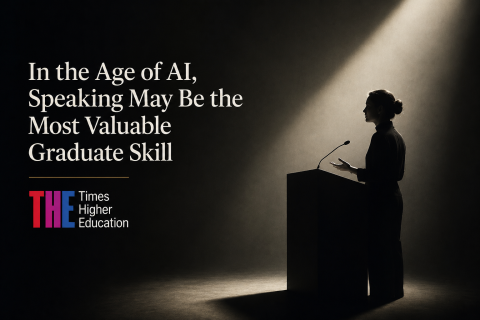
In a recent opinion piece for Times Higher Education, Bruce Hood argued that as AI becomes increasingly capable of producing polished written work, universities must rethink how they develop and assess one of the most important graduate attributes: the ability to communicate knowledge effectively to other human beings.
For decades, universities have focused primarily on written communication. Essays, reports, dissertations and examinations have been the traditional ways students demonstrate understanding. But the emergence of generative AI raises an uncomfortable question: if a machine can help produce convincing written work, how can employers, educators and society distinguish between possessing knowledge and simply presenting it?
The answer may lie in a skill that has often been overlooked within higher education: spoken communication.
Communication Beyond Writing
The ability to explain complex ideas clearly has always mattered. Whether presenting research, pitching a business proposal, explaining technical concepts to clients, or leading a team, professional success often depends on communicating knowledge effectively.
Employers recognise this. Across multiple surveys, verbal communication consistently ranks among the most sought-after graduate attributes. Yet many students complete their degrees having received relatively little formal training in public speaking, audience engagement or persuasive communication.
This is particularly surprising given that communication is not simply the transmission of information. Effective speakers must think on their feet, respond to questions, establish credibility, build trust and adapt to their audience in real time. These are deeply human skills that AI cannot easily replicate.
Knowledge Is Not Enough
Good communication begins with understanding.
One concern is that AI may allow students to engage less deeply with the material they are studying. If students rely on AI to generate essays and reports, they may miss the intellectual struggle that often produces genuine comprehension.
But even deep knowledge is not sufficient on its own.
Many graduates possess considerable expertise but struggle to explain it to non-specialists. Anyone who has attended an academic conference knows that expertise and communication ability do not always go hand in hand.
Communication is a skill that requires practice, feedback and repetition. Like any complex ability, it improves through deliberate effort.
Why Three Minute Thesis Matters
This is one reason the Three Minute Thesis (3MT®) competition has become such a global success.
Developed by the University of Queensland and now adopted by more than a thousand institutions worldwide, 3MT challenges doctoral researchers to explain years of work in just three minutes using language that a general audience can understand.
The challenge is deceptively difficult.
Researchers must identify the core message of their work, strip away unnecessary jargon, construct a compelling narrative and connect with an audience that may know nothing about their field.
In doing so, they develop precisely the communication skills that employers, policymakers, journalists and the public increasingly value.
The Problem of Visibility
Yet there is another challenge.
Every year, thousands of students participate in competitions, public engagement events, conference presentations and research showcases. These experiences develop valuable communication skills, but the evidence often disappears once the event concludes.
A presentation may be uploaded to YouTube, buried within a university playlist, and never seen again.
The achievement itself becomes difficult to discover, verify or showcase.
Why My-Thesis?
My-Thesis was created to address this problem.
The platform provides a searchable index of research presentations, enabling graduate researchers to make their talks more discoverable and giving audiences a way to find research by topic, institution, researcher or keyword.
But the platform is about more than research visibility.
At its core, My-Thesis recognises communication as an academic achievement in its own right.
A successful presentation demonstrates not only what a researcher knows but also their ability to explain, persuade and engage. These are increasingly important skills in a world where information is abundant but understanding remains scarce.
Looking Forward
Artificial intelligence is undoubtedly transforming education. Universities will continue to debate how best to assess knowledge and maintain academic integrity in an age of AI-assisted learning.
However, one consequence seems increasingly clear.
The graduates who thrive will not simply be those who possess knowledge. They will be those who can communicate it effectively, authentically and persuasively.
The ability to stand in front of an audience and explain an idea clearly may become one of the most valuable skills a graduate can possess.
And that is precisely why platforms such as My-Thesis matter more than ever.