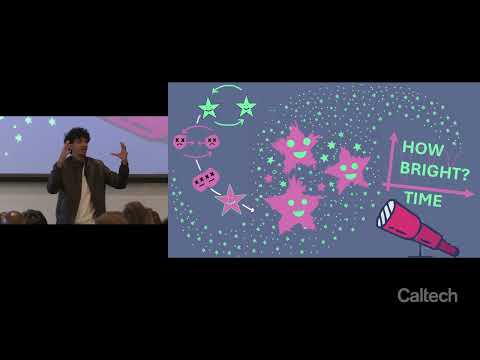
This research investigates “zombie stars” — reanimated white dwarf systems formed through stellar interactions in binary star systems. By analyzing large-scale brightness variations across the Milky Way, the work identified hundreds of these rare objects, providing new insights into stellar evolution, galactic history, and the future lifecycle of stars in our universe.
My talk explains how neutron stars—extremely dense remnants of stellar explosions—contain matter we cannot study on Earth. By analyzing gravitational waves from colliding neutron stars, the speaker models how their deformation (or “squishiness”) reveals their internal composition. This method may uncover entirely new forms of matter and transform fundamental physics.

The researcher studies how clouds on distant exoplanets affect their climates and potential for life. Working with NASA, they model how exotic materials—like iron or sapphire clouds—absorb and reflect light. They found particle shape greatly influences temperature and habitability, helping determine whether alien worlds could support liquid water and life.