
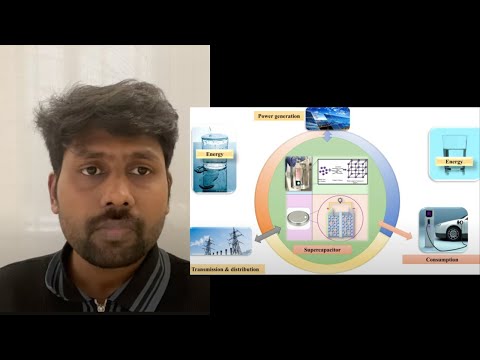
Batteries charge slowly and degrade over time. This research develops advanced supercapacitors using novel 2D materials and water-based electrolytes. The resulting devices charge rapidly, store five times more energy than conventional supercapacitors, last over 50,000 cycles, and offer a fast, affordable alternative for electric vehicles and energy storage.

This research explores how rearranging atoms in crystal thin films can radically change material behavior. By engineering strain and atomic orientation in lanthanum strontium manganite films, the work links structure to electrical and magnetic properties, enabling the design of custom materials for next-generation electronics and computing technologies.
2025
This research develops a high-performance supercapacitor using a conductive iron-based metal–organic framework. By overcoming low electrical conductivity, the material enables rapid charging and long cycle life, achieving storage performance three times higher than existing designs. The work advances next-generation energy storage solutions beyond conventional batteries.

This research develops sustainable screen materials using nanoscale “sponges” that trap light-emitting molecules. By converting these materials into ultra-thin nanosheets, the study offers brighter, longer-lasting, and energy-efficient alternatives to toxic, non-renewable screen components, reducing environmental impact while supporting future global screen demand.
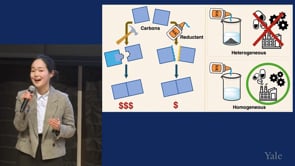
This research develops stable, low-cost homogeneous reductants that act like “super glue” for chemical bond formation. By replacing unpredictable metal powders, it enables more efficient, scalable, and affordable chemical synthesis, with major implications for pharmaceuticals, advanced materials, and sustainable industrial chemistry.

2025
This research advances metal additive manufacturing by replacing wasteful machining with laser-based powder fusion. Inspired by baking, printed metal parts are optimized through microstructural analysis. The approach produces complex geometries with equal or superior strength and durability while significantly reducing material waste, enabling cleaner, more sustainable manufacturing.

Rising global electricity demand requires materials that conduct efficiently at extreme temperatures. This research develops scalable metal–ceramic composite conductors with tunable electrical properties by controlling particle interfaces and packing. These materials overcome limitations of metals and semiconductors, enabling efficient, affordable energy technologies for high-temperature industrial applications.

Chemical reactions are often slow and depend on catalysts. This research shows that simply applying electrical charge to a catalyst—without using energy—dramatically accelerates reactions, increasing rates tenfold for every 60 mV. A AA battery can reduce a universe-long reaction to one second, offering a powerful, sustainable route for chemical manufacturing.
2025
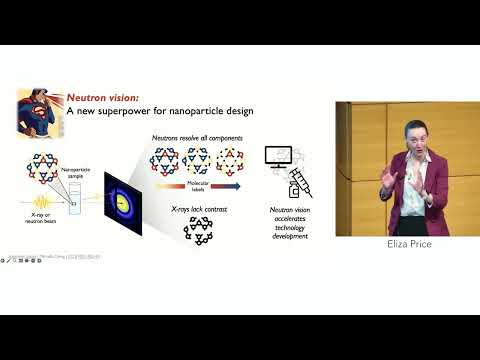
This research uses neutron scattering — “neutron vision” — to reveal the full structure of complex nanoparticles that X-rays can’t fully resolve. By developing statistical methods to optimise experiment design and analyse data, the project enables clearer structural insights, accelerating the development of advanced materials for energy, medicine and nanotechnology.

This research investigates how turbine disc cracks grow under real engine conditions. By replicating extreme temperatures and loading cycles, including the high forces at take-off, the findings reveal a counter-intuitive effect: take-off loads actually slow crack growth by preventing oxide formation. This improves lifetime predictions, increases safety, and reduces operational costs.