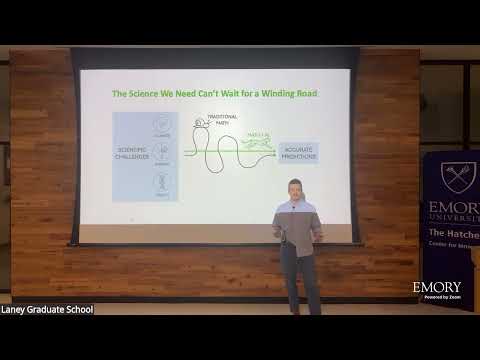
This research uses artificial intelligence to accelerate scientific simulations by learning patterns from traditional mathematical models. Rather than replacing physics, the AI predicts efficient starting points for complex calculations, producing accurate results much faster. The approach could dramatically speed up research in fields such as medicine, engineering, and climate science.

2026
This research investigates whether ordinary matter can generate enough negative energy to keep a wormhole open. Combining theoretical calculations with computer simulations, it finds that nature tightly limits negative energy, making traversable wormholes unlikely. The work highlights how science tests imaginative ideas through rigorous mathematics and physical laws.
This research addresses the challenge of building stable quantum computers by modelling superconducting qubits. It develops simulation tools to predict behaviour, optimise design, and reduce errors caused by environmental disturbances. By improving qubit reliability, the work supports scalable quantum computing capable of solving complex problems beyond classical computational limits.