This dissertation presents temporal-difference learning methods for building world models that enable intelligent agents and robots to predict, plan and act. It introduces TD-MPC, which learns compact latent dynamics, rewards and value estimates for model-predictive control, and TD-MPC2, a more robust successor requiring little task-specific tuning. Experiments demonstrate faster real-world robot learning, scalable multitask performance and a unified model spanning 200 tasks across ten domains. The research also examines interactive generative world models and their tendency to hallucinate physically implausible futures. Targeted data collection in uncertain regions substantially reduces these errors, suggesting routes toward safer, uncertainty-aware autonomous systems and robotics.
This research develops bio-inspired autonomous underwater vehicles by combining evolutionary simulation with physical prototype testing. Optimising swimmer shape and motion through an iterative feedback loop enables more energy-efficient AUVs capable of long-range ocean monitoring, supporting environmental observation, infrastructure inspection, and maritime surveillance across Canada's vast marine environments.
This research explores how heterogeneous AI agents can establish common ground during collaboration. By separating communication and action into distinct decision-making policies, agents can engage in micro-conversations that create shared understanding. The work aims to improve teamwork among diverse robots and support future human-AI collaboration in complex environments.
This research develops a distributed multi-robot task allocation framework that enables autonomous robots to estimate tasks, share information, coordinate assignments, and avoid collisions without relying on a central server. The approach improves efficiency, scalability, and resilience, with applications in emergency response, particularly supporting firefighters during life-saving operations.
This research combines bio-inspired robotics and reinforcement learning to develop adaptable amphibious robots modeled after sea turtles. By learning through trial and error across diverse terrains, these robots can adjust their movement strategies in real time, improving performance in applications such as environmental monitoring, search and rescue, and agriculture.
This research develops programmable active materials that function like soft robots without electronics or external control systems. Using 3D-printed liquid crystal elastomers, the work engineers materials that sense temperature and autonomously deform, fold, and locomote, demonstrating how microscopic material structure can be programmed to produce complex robotic behavior.
This research explores how artificial intelligence systems can continue learning without forgetting previously acquired knowledge. Instead of erasing old information, the proposed method compresses knowledge into more efficient representations, allowing AI systems such as self-driving cars to adapt safely to new environments while avoiding dangerous performance failures during learning.
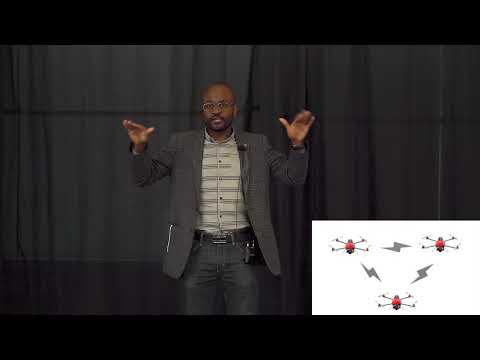
This research improves drone-based search and rescue by creating networks of communicating drones that optimize data routing. Inspired by traffic flow, it minimizes delays by avoiding congested paths. Faster data transmission enables quicker detection and response, allowing larger areas to be searched efficiently and increasing the chances of saving lives.
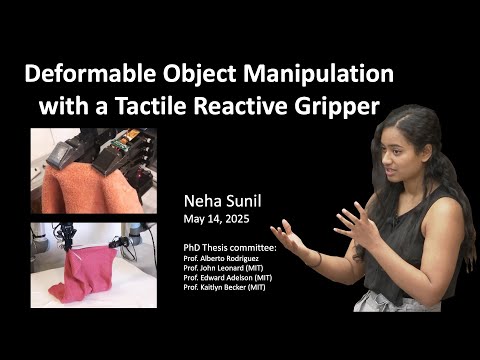
This research presents a modular visuotactile robotic system for manipulating deformable objects such as cables, towels, and garments. Unlike rigid-object manipulation, deformables pose challenges due to occlusion, complex dynamics, and high variability. The system combines vision for global context and tactile sensing (GelSight) for precise local control, enabling tasks like cable tracing, cloth edge following, towel folding, and garment handling. It uses reactive control, learned dynamics (LQR), affordance models, and dense correspondence to generalise across tasks and objects. A key innovation is shifting from global state estimation to local, feedback-driven manipulation, improving robustness, efficiency, and real-world applicability in domains like manufacturing, healthcare, and assistive robotics.
This research explores swarms of small, modular robots that cooperate like ant colonies to perform complex tasks. Using control theory, optimization, and machine learning, the work enables resilient, energy-efficient robotic systems that adapt in real time, with applications ranging from disaster response and space exploration to medical technologies.