
This research develops a brain-inspired optical imaging system that mimics human vision to reconstruct objects hidden by fog, smoke, and biological tissue. Combining event-based cameras, spiking neural networks, and neuromorphic processors, it enables fast, energy-efficient imaging with applications in autonomous vehicles, emergency response, and non-invasive medical diagnostics.
2026
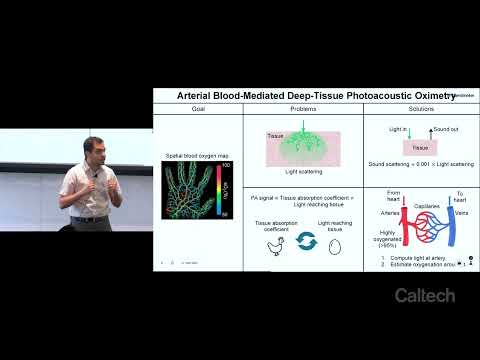
This research improves photoacoustic imaging, a technique that uses light-generated sound waves to visualize tissue oxygenation deep inside the body. By calibrating measurements using highly oxygenated arterial blood, the method overcomes longstanding accuracy limitations and avoids skin-tone bias, potentially improving early tumor detection and non-invasive monitoring of tissue health.
This research improves fluorescent imaging by enhancing the brightness of long-wavelength dyes. By encapsulating flexible squaraine dyes within macrocyclic rings, molecular motion is restricted, reducing energy loss and increasing light emission. The result is brighter, clearer imaging, enabling better visualization of biological structures such as cells and cancer tissue.