This research develops intelligent polymer membranes that selectively capture carbon dioxide using molecular simulations to design highly efficient gas-separation materials. By improving carbon capture at industrial sources, the technology could reduce greenhouse gas emissions, support cleaner energy systems, and contribute to tackling one of the world's greatest challenges: climate change.

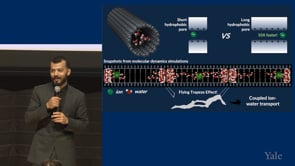
This research uses molecular simulations to study how ions and water move through nanopores, revealing counterintuitive effects of pore length and ion–water coupling. Understanding these nanoscale transport mechanisms helps improve desalination membrane design and provides insight into highly efficient biological channels such as aquaporins.