
This research investigates gluon saturation, an extreme state of matter that existed immediately after the Big Bang. By developing precise theoretical calculations for particle collision experiments, it helps scientists understand how gluons bind quarks to form matter, revealing the fundamental processes that shaped the early universe and made life possible.

This research explores the philosophical foundations of particle physics and the Standard Model. Focusing on neutrinos, it argues that these particles may be better understood as different states of a single entity rather than separate objects. The project aims to develop a deeper ontology describing the fundamental structure of physical reality.
2025
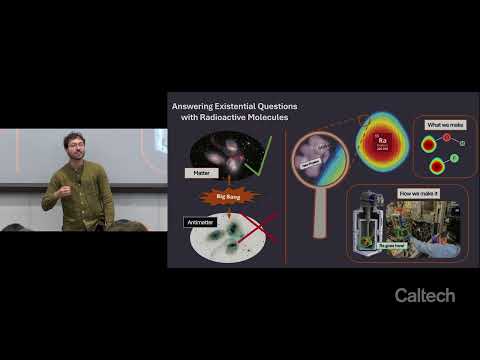
This research develops tabletop methods for studying rare radium-containing molecules to search for broken symmetries between matter and antimatter. Because radium’s asymmetric nuclear structure strongly amplifies subtle physical effects, these molecules provide highly sensitive probes for new physics that could help explain why matter exists in the universe after the Big Bang.
This research studies neutrinos—elusive particles that rarely interact with matter—and their ability to change type, known as neutrino oscillation. Using detectors in Japan, the experiment compares neutrinos before and after travel. Improved near-detector accuracy enables precise measurements, helping explain fundamental questions about matter, antimatter, and the structure of the universe.
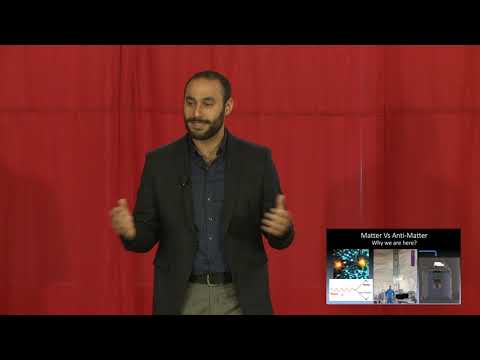
This research investigates why matter dominates over antimatter in the universe. By isolating xenon isotopes deep underground, scientists aim to detect rare nuclear reactions that could explain this imbalance. The work involves large-scale gas processing and long-term observation, potentially revealing fundamental insights into the origin of matter and existence.
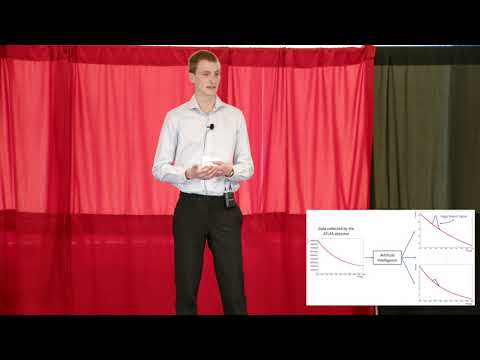
This research uses AI to detect subtle interactions between the Higgs boson and muons at the Large Hadron Collider. By refining large datasets, it aims to uncover how particles acquire mass at smaller scales. Confirming this interaction would deepen understanding of the Higgs field and fundamental physics.

2026
This research searches for dark matter, which makes up most of the universe’s mass, by detecting ultralight particles using sensitive quantum sensors. By scanning frequencies like a radio and minimizing noise at cryogenic temperatures, the experiment aims to identify faint signals, bringing scientists closer to understanding the fundamental composition of the universe.
2020
This research examines unexpected beauty-quark decay patterns observed at LHCb that violate Standard Model predictions. The anomalies suggest a new force and a hypothetical leptoquark particle that couples mainly to third-generation matter. By modelling these effects, the work guides experimental searches and may shed light on the long-standing mystery of particle-generation hierarchies.

The researcher studies how clouds on distant exoplanets affect their climates and potential for life. Working with NASA, they model how exotic materials—like iron or sapphire clouds—absorb and reflect light. They found particle shape greatly influences temperature and habitability, helping determine whether alien worlds could support liquid water and life.