This research investigates how wind transports sand across Mars to improve the safety of future space missions. Combining measurements from Earth-based analogue dunes with computational modelling and NASA satellite data, the approach predicts Martian winds and sandstorms with high accuracy, potentially reducing landing risks and supporting future human exploration of Mars.
This research uses LiDAR and individual tree segmentation to replace traditional polygon-based forest inventories with precise, tree-level data. By modelling the growth and interactions of individual trees, it enables more accurate forest management, improving timber planning, ecosystem resilience, and climate adaptation while supporting sustainable forestry across British Columbia.

2026
This research improves weather and climate forecasting by studying how dry air mixes into thunderstorm clouds, a process called entrainment. Using satellite observations, radar data, and interpretable machine learning, the work refines outdated cloud physics models, helping scientists better predict severe weather, hurricanes, and long-term climate behavior.
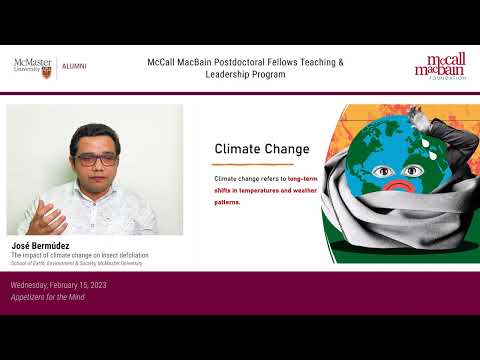
This talk explains how climate change can increase insect-driven defoliation by raising insect activity, survival, and range expansion. It argues that defoliation threatens forests, crops, and food security, and shows how remote sensing and machine learning can help detect outbreaks early, support monitoring, and guide policy and prevention efforts.
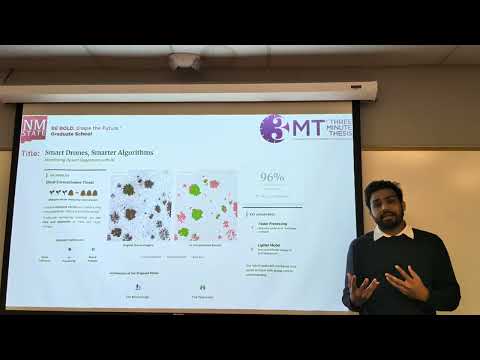
This research uses drone imagery and a hybrid AI model to classify rangeland cover as green vegetation, dead vegetation, or bare soil. Combining two neural network approaches achieved 96% accuracy while requiring only simple, low-cost sensors. The method enables fast, large-scale monitoring to combat invasive shrubs and support sustainable land management.
This study modeled wild edible mushroom yields in Mediterranean forests using Planet satellite imagery, LiDAR, climate data, and field measurements. Results show that seasonal NDVI differences, precipitation, and forest structure are key predictors. Integrating high-resolution intra-annual remote sensing significantly improves yield prediction and ecological understanding.
This study analyzed long-term changes in forest composition in the Spanish Iberian Range using National Forest Inventory data and Landsat imagery. Results show a significant shift from monospecific to mixed forests, with mixed stands nearly doubling over three decades. Satellite-derived vegetation indices successfully detected these temporal dynamics.
This study examines whether burned area from forest fires in Portugal can be predicted using satellite, weather, and time-series data. Results show human-caused fires dominate over natural ones, and predictive models achieved around 95% accuracy, demonstrating strong potential for improving resource allocation and fire management strategies.
This study evaluated a PointNet++ deep learning model for binary classification of Pinus sylvestris and Quercus pyrenaica using only LiDAR 3D point clouds. A balanced dataset of 160 trees achieved 91% accuracy, showing that geometric features alone can effectively discriminate species, highlighting the potential of lightweight AI models for forest inventories.
This study evaluated multispectral and hyperspectral vegetation indices to estimate wildfire severity in the 2022 Sierra de la Culebra fire. Field Composite Burn Index data were correlated with satellite-derived indices. Results showed hyperspectral imagery provided more accurate severity estimates, particularly using Cellulose Absorption Index and Red Edge indices.