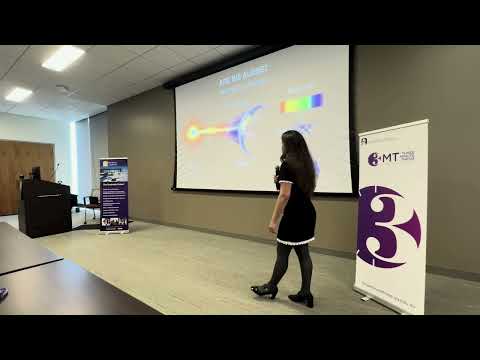
This research uses artificial intelligence and machine learning to analyze light from distant exoplanets. By interpreting atmospheric spectral signatures, it aims to identify potentially habitable worlds and search for signs of life beyond Earth. The work supports future space missions designed to answer one of humanity’s oldest questions: Are we alone?
This research improves fluorescent imaging by enhancing the brightness of long-wavelength dyes. By encapsulating flexible squaraine dyes within macrocyclic rings, molecular motion is restricted, reducing energy loss and increasing light emission. The result is brighter, clearer imaging, enabling better visualization of biological structures such as cells and cancer tissue.