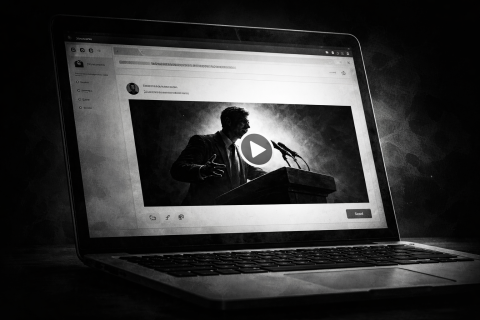
Academic inboxes are crowded. Between calls for papers, administrative messages, newsletters, and teaching communications, even genuinely important emails are easy to overlook. For researchers trying to share their work—whether with supervisors, collaborators, institutions, or external partners—standing out is increasingly difficult.
One simple strategy consistently cuts through the noise: video.
Short, well-crafted video messages can dramatically increase engagement, clarity, and response rates. For platforms like my-thesis.org, which focus on authentic spoken research communication, video emails are not marketing gimmicks—they are an extension of how scholars already explain, defend, and share ideas.
Below we outline why video works in academic contexts and how researchers can use video email effectively, without turning scholarship into sales.
1. Video increases engagement and response: Market research consistently shows that emails containing video outperform text-only messages in both open and click-through rates. This matters for researchers when:
- Requesting feedback on work
- Introducing themselves to potential collaborators
- Sharing research outputs beyond journals
- Contacting institutions, funders, or industry partners
Video reduces the cognitive effort required to understand complex ideas and increases the likelihood that recipients will actually engage.
2. Video makes research more memorable: We are far more likely to remember visual explanations than dense text. Spoken explanations allow researchers to:
- Emphasise the why behind their work
- Use analogy and narrative
- Signal confidence and credibility
This is precisely why formats such as the 3-Minute Thesis work so well—and why short video emails can act as a gateway to deeper engagement with research.
3. Video humanises expertise: Academic emails often sound interchangeable. Video reintroduces:
- Voice
- Expression
- Presence
This is particularly valuable for early-career researchers, where trust and visibility matter. A short video allows recipients to see who is behind the research, not just the project title or affiliation.
4. Video can save time—for everyone: Long explanatory emails are inefficient. A 30–60 second video can replace several paragraphs of clarification, reduce back-and-forth, and prevent misunderstandings—especially when explaining:
- Methods
- Concepts outside one’s discipline
- The motivation behind a project
Where video emails work especially well in academia
Researchers commonly use video emails to:
- Introduce themselves to potential supervisors or collaborators
- Share a recorded 3-Minute Thesis or public talk
- Explain a grant idea or project overview
- Support teaching and supervision communication
- Promote public engagement or impact activities
Platforms like my-thesis.org extend this further by linking short talks to verified researchers and institutions, allowing video communication to remain credible, contextualised, and discoverable.
Final thought
Email is not disappearing—academic inboxes will only get busier. As research becomes more interdisciplinary and public-facing, spoken explanation is becoming a core scholarly skill, not an optional extra.
Short video emails are not about self-promotion. They are about clarity, accessibility, and human connection—all of which sit at the heart of good research communication.
For researchers who already know how to explain their work aloud, video is simply the most direct way to let others hear it.